Software Architecture often sounds like a mystical art practiced by gray-bearded wizards in ivory towers. In reality, it's just about making the hard decisions—the ones that are difficult to change later.
To demystify these concepts, I've applied the Richard Feynman Technique: taking complex ideas from the incredible O'Reilly 2024 Software Architecture collection and explaining them using simple, relatable analogies.
Let's dive in.
1. The Architect Elevator
In The Software Architect Elevator, Gregor Hohpe explains that a modern architect isn't just a technical genius; they are a communicator.
Imagine a massive corporate skyscraper. At the top, in the luxurious penthouse boardroom, business executives are plotting the company's strategic goals. At the very bottom, in the noisy, bustling engine room (the data center or development floor), engineers are wiring cables and writing code.
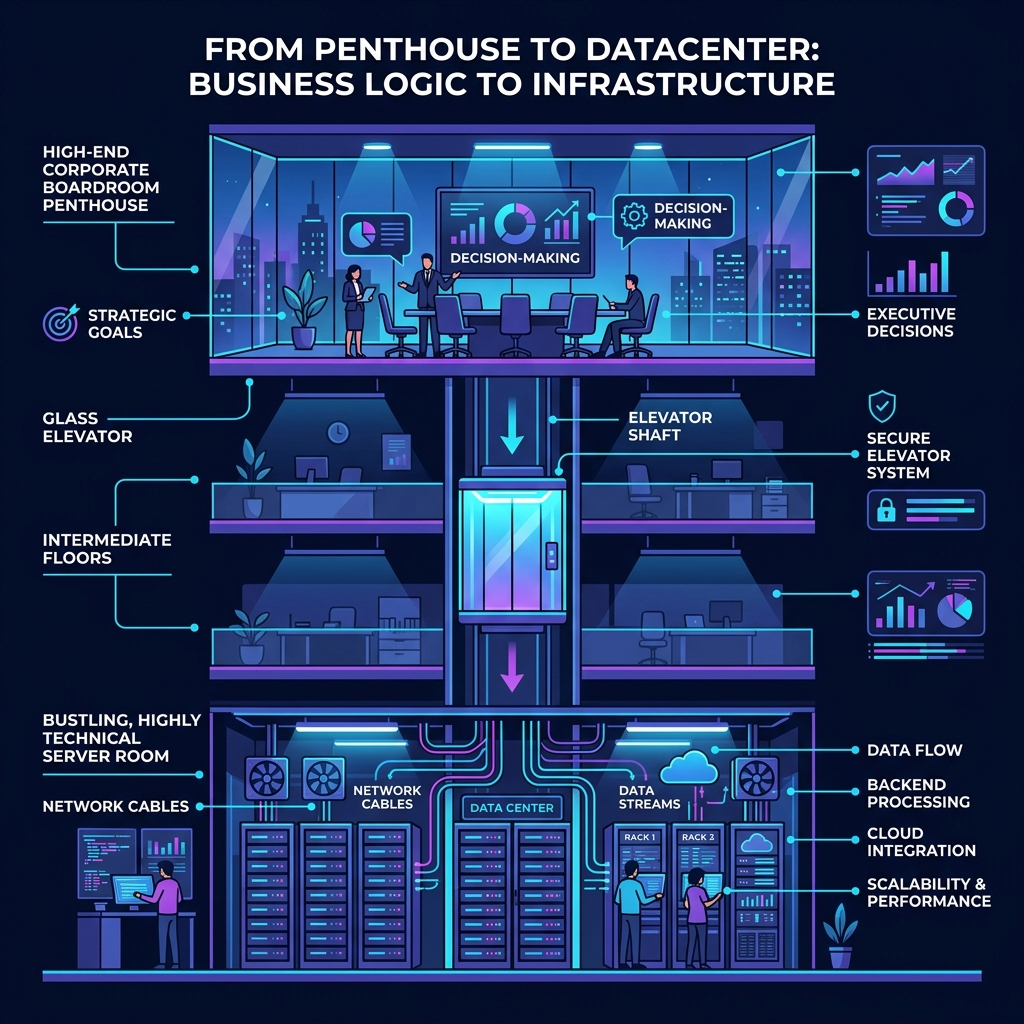 The Architect Elevator connects the penthouse strategy to the engine room execution.
The Concept: The architect is the person riding the elevator. They must be able to speak the language of business ("ROI," "Time to Market") in the penthouse, and then ride the elevator down to the engine room and translate that into technical reality ("Latency," "Database Sharding," "Microservices"). If the elevator is broken, the strategy never becomes reality.
2. The First Law of Architecture: "It Depends"
If you ask an architect a question, the answer is almost always: "It depends." Neal Ford and Mark Richards emphasize this in Fundamentals of Software Architecture and Software Architecture: The Hard Parts.
Think of architecture like designing a car. Do you want a Formula 1 race car or a Volvo station wagon? You can't have both.
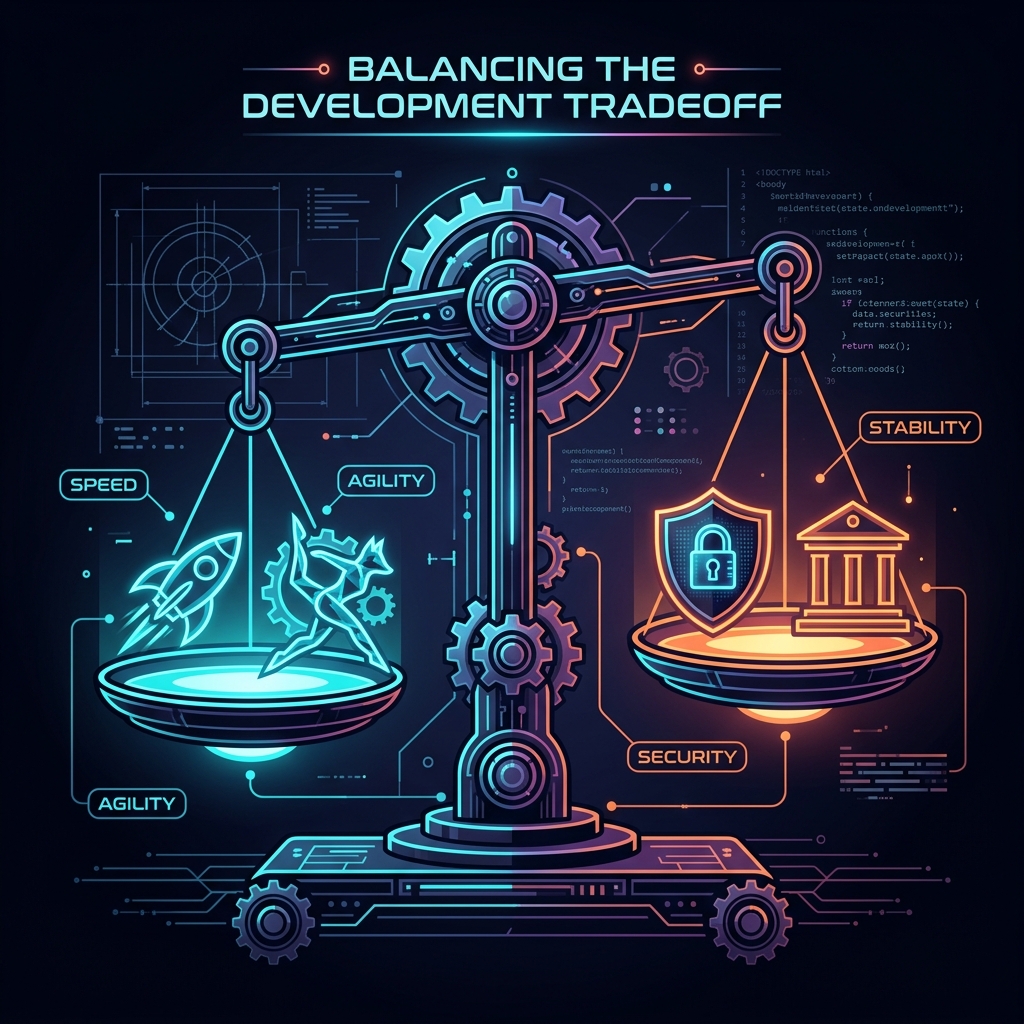 Balancing the scales: Speed and Agility vs. Security and Stability.
The Concept: In software, there are no perfect solutions, only trade-offs. You are constantly balancing "-ilities":
- Scalability (handling more users) often costs Money.
- Security (locking things down) often reduces Usability.
- Agility (moving fast) can sometimes threaten Stability. An architect's job isn't to find the "right" answer; it's to find the trade-off that best fits the business goal.
3. Breaking the Monolith: Lego Blocks vs. A Ball of Yarn
Sam Newman's books (Building Microservices and Monolith to Microservices) tackle one of the biggest trends of the last decade: breaking apart massive applications.
Imagine your software is a giant, tangled ball of multicolored yarn (a Monolith). If you pull one red string on the left side, a blue string on the right side tightens. Everything is connected. Changing one thing might break something completely unrelated.
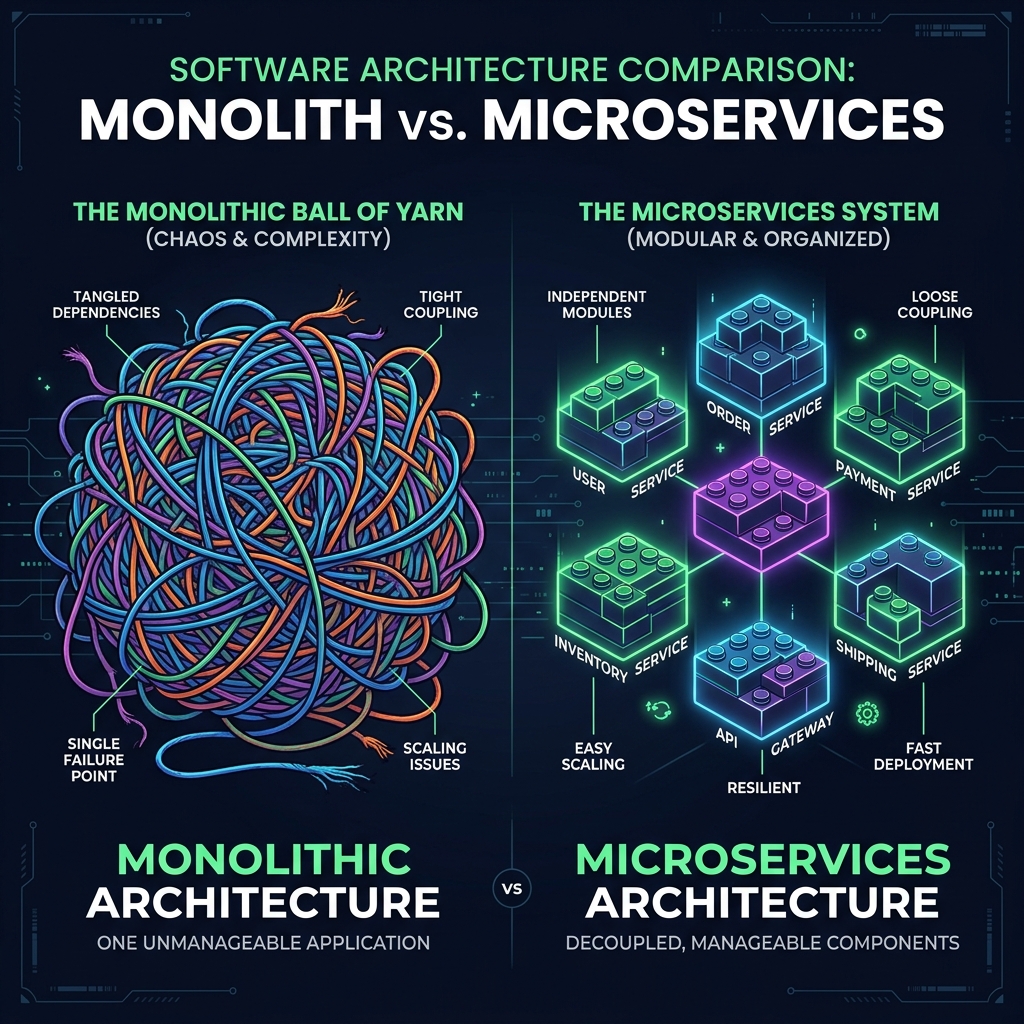 A tangled ball of yarn (Monolith) vs. neatly organized Lego blocks (Microservices).
The Concept: Microservices are like playing with Lego blocks. You break the giant ball of yarn into small, independent pieces. If you want to replace a red 2x4 Lego brick with a blue one, you can do it without destroying the whole castle. However, managing 1,000 separate Lego blocks comes with its own massive operational headache (the "Distributed Monolith" trap).
4. Domain-Driven Design (DDD): The Shared Dictionary
Before you write a single line of code, you need to understand what you are building. This is the core of Vlad Khononov's Learning Domain-Driven Design.
Imagine a group of French chefs trying to build a house with Japanese carpenters, but neither speaks the other's language. The chefs ask for a "soufflé station," and the carpenters build a "tatami room." Disaster.
 Building a 'Ubiquitous Language' bridge between business and engineering.
The Concept: The most important part of DDD is the Ubiquitous Language. Business experts and software developers must sit down and create a shared dictionary. If the business calls a customer a "Guest," the code shouldn't call them a "User." The code must strictly reflect the actual business domain. Code is just the physical manifestation of business rules.
5. Evolutionary Architecture: Buildings That Expect Change
Historically, software architecture was like building a concrete bridge. Once it's built, changing it is incredibly painful. But the business world changes daily. Neal Ford, Rebecca Parsons, and Patrick Kua explore a different approach in Building Evolutionary Architectures.
Imagine building a skyscraper not with concrete, but with massive, modular shipping containers. As the company grows, a giant crane can lift out an old container and slot a new, upgraded one right into its place without the building falling down.
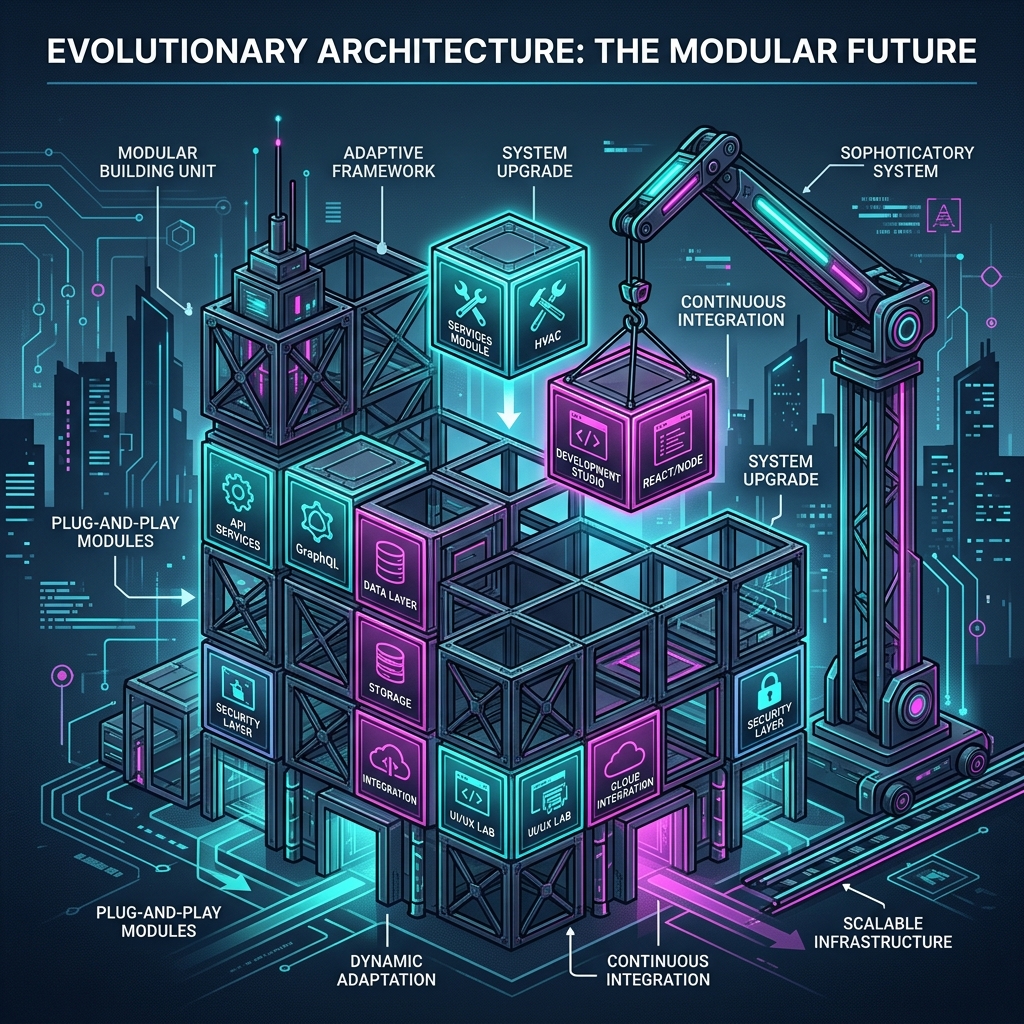 A building designed for constant upgrades and interchangeable modules.
The Concept: Evolutionary Architecture assumes that change is the only constant. Instead of trying to predict the future, architects build systems that are designed to be easily modified. They use "fitness functions" (like automated architectural tests) to ensure that as the system evolves, it doesn't degrade in performance or security.
The Verdict
Software Architecture is less about coding and more about communication, balancing trade-offs, and predicting where things might go wrong. By using the Feynman Technique to understand the underlying principles—elevators, scales, Legos, dictionaries, and modular buildings—we can strip away the jargon and focus on what really matters: solving human problems with technology.
References & Further Reading
This post is a synthesis of the following excellent resources from the O'Reilly 2024 Software Architecture collection:
- The Software Architect Elevator by Gregor Hohpe
- Fundamentals of Software Architecture by Mark Richards and Neal Ford
- Software Architecture: The Hard Parts by Neal Ford, Mark Richards, Pramod Sadalage, and Zhamak Dehghani
- Building Microservices (2nd Edition) by Sam Newman
- Monolith to Microservices by Sam Newman
- Learning Domain-Driven Design by Vlad Khononov
- Building Evolutionary Architectures (2nd Edition) by Neal Ford, Rebecca Parsons, and Patrick Kua