If you've been in software engineering long enough, you've likely encountered a codebase that feels impossible to understand. A simple feature request—like adding an urgent tag to an order—ends up breaking the shipping module and corrupting the billing records.
Why does this happen? Usually, it's because the software was built without deeply understanding the real-world business it was supposed to solve. Developers focused on database tables and APIs instead of focusing on the domain.
Enter Domain-Driven Design (DDD). Coined by Eric Evans in his seminal 2003 book, it is an approach to software development that centers the project on the core business domain.
Let's break down this famously dense topic using the Richard Feynman technique—simplifying complex ideas with everyday analogies.
1. The Big Picture: Strategic vs. Tactical
Domain-Driven Design is broadly divided into two distinct halves: Strategic Design and Tactical Design.
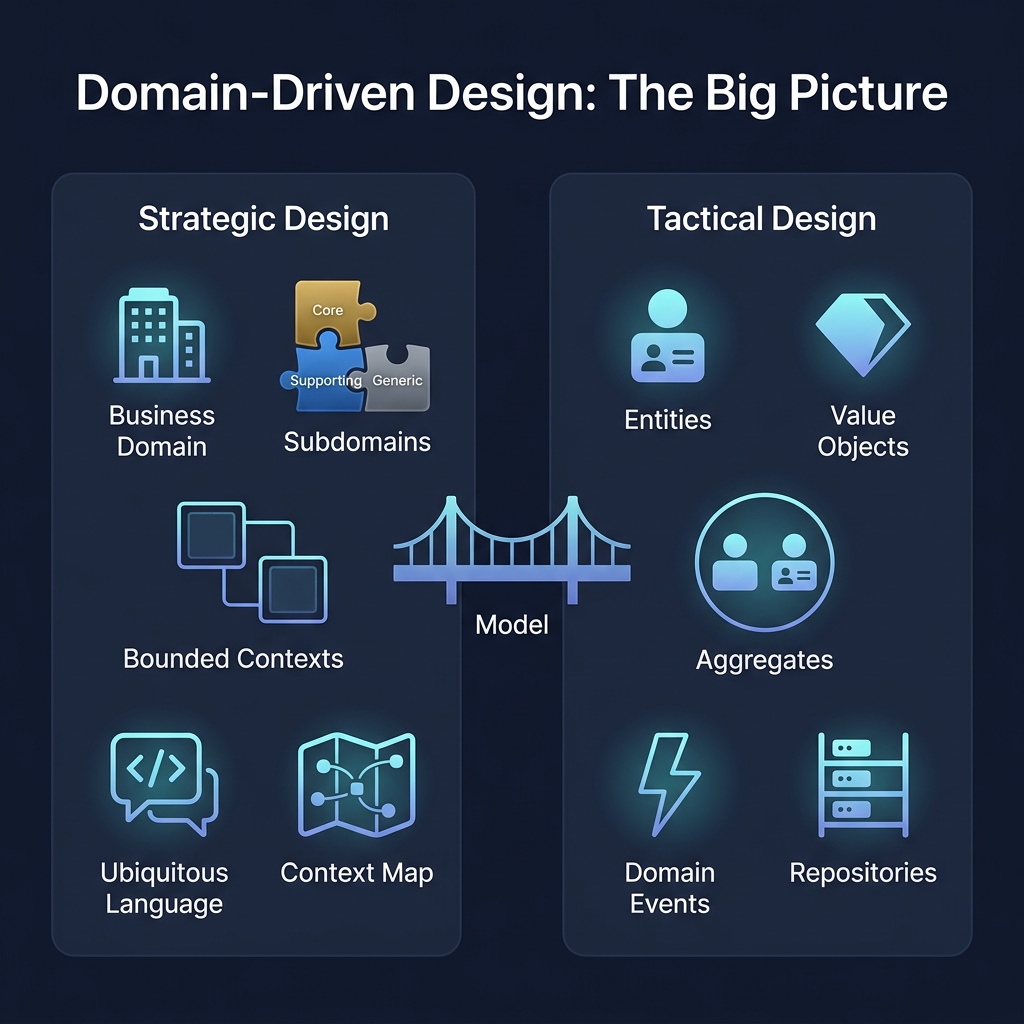 The interplay between Strategic (the "What" and "Why") and Tactical (the "How") design.
- Strategic Design is for architects and business leaders. It's about deciding what to build, identifying what is truly important, and establishing clear boundaries so teams don't step on each other's toes.
- Tactical Design is for the developers in the trenches. It provides specific coding patterns (like Entities, Value Objects, and Aggregates) to build complex business logic cleanly.
You cannot have a successful DDD project using only Tactical patterns—that's just writing clean code for the wrong problem. You must start with Strategy.
2. Strategic Design: The Restaurant Analogy
Before writing a single line of code, you must distill the large problem domain into smaller, manageable chunks called Subdomains.
Imagine you are building the software for a massive, global Restaurant Chain. The entire operation is your Business Domain. But you can't build it all at once, and not all parts are equally important.
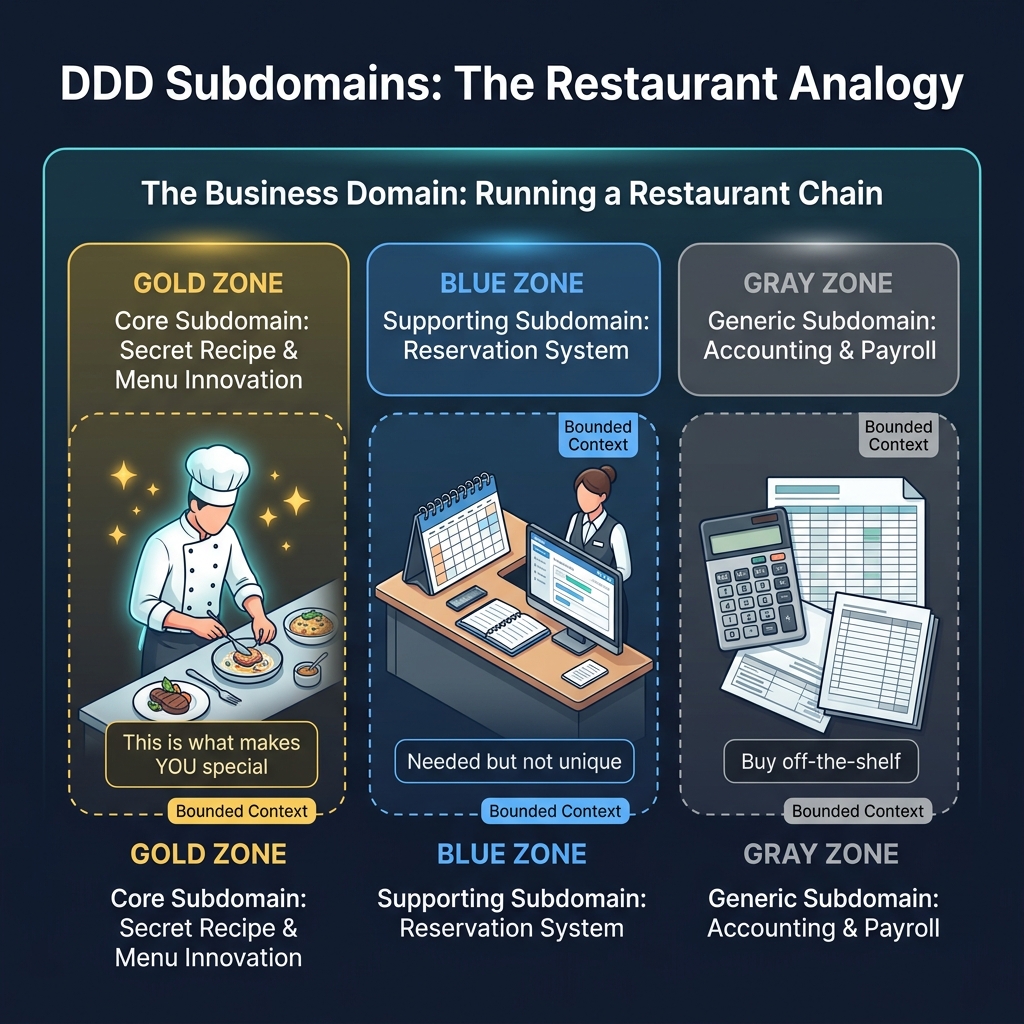 Focus your best engineers on your core competitive advantage.
According to DDD, there are three types of subdomains:
- Core Subdomain (The Secret Recipe): This is your competitive advantage. It's what makes the business unique. For a highly innovative restaurant, it's the recipe creation and menu optimization. The business must build this in-house with its best developers because it dictates their success.
- Supporting Subdomain (The Reservation System): This is necessary for the business to function, but it doesn't give you a competitive edge. Your reservation system needs to work perfectly, but nobody chooses to eat at your restaurant because of the reservation software. You dedicate fewer resources here, or perhaps outsource it.
- Generic Subdomain (Accounting & Payroll): This is a complex problem, but it's the exact same problem every other company has. You do not gain a competitive advantage by inventing your own payroll software. You simply buy an off-the-shelf solution.
3. Resolving the Tower of Babel: Ubiquitous Language
The number one reason software projects fail isn't technology; it's miscommunication between the people building the software and the people using it.
Developers talk about "Rows," "Foreign Keys," and "DTOs." Business experts talk about "Policyholders," "Claims," and "Underwriting."
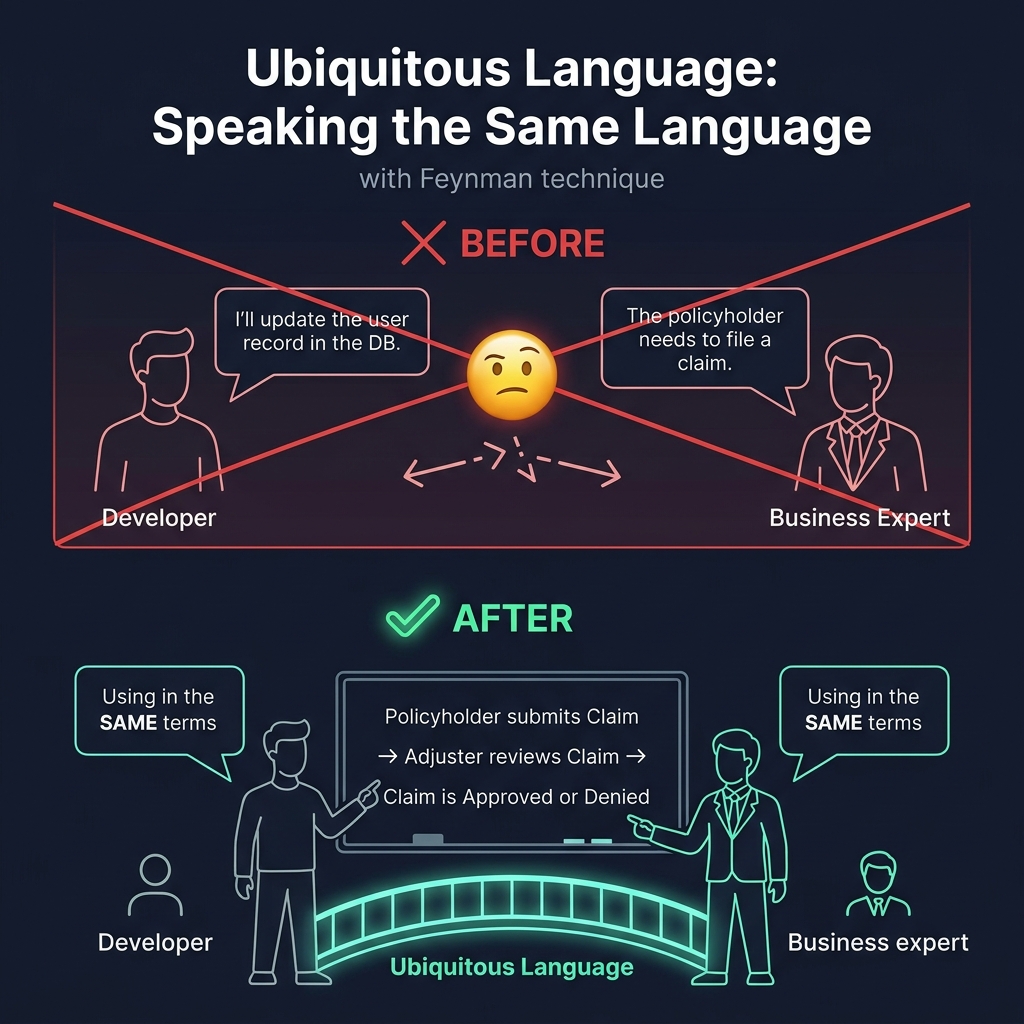 Eradicating translation layers through a shared language.
DDD forces both sides to agree on a Ubiquitous Language. This is a strict, shared vocabulary. If the business expert calls it a "Guest," the developer cannot create a database table called Users. The code must reflect the business language perfectly. If a new developer reads the code, it should read like a manual for the business.
4. Setting Fences: Bounded Contexts
As a company grows, the Ubiquitous Language hits a wall. Different departments use the exact same word to mean completely different things.
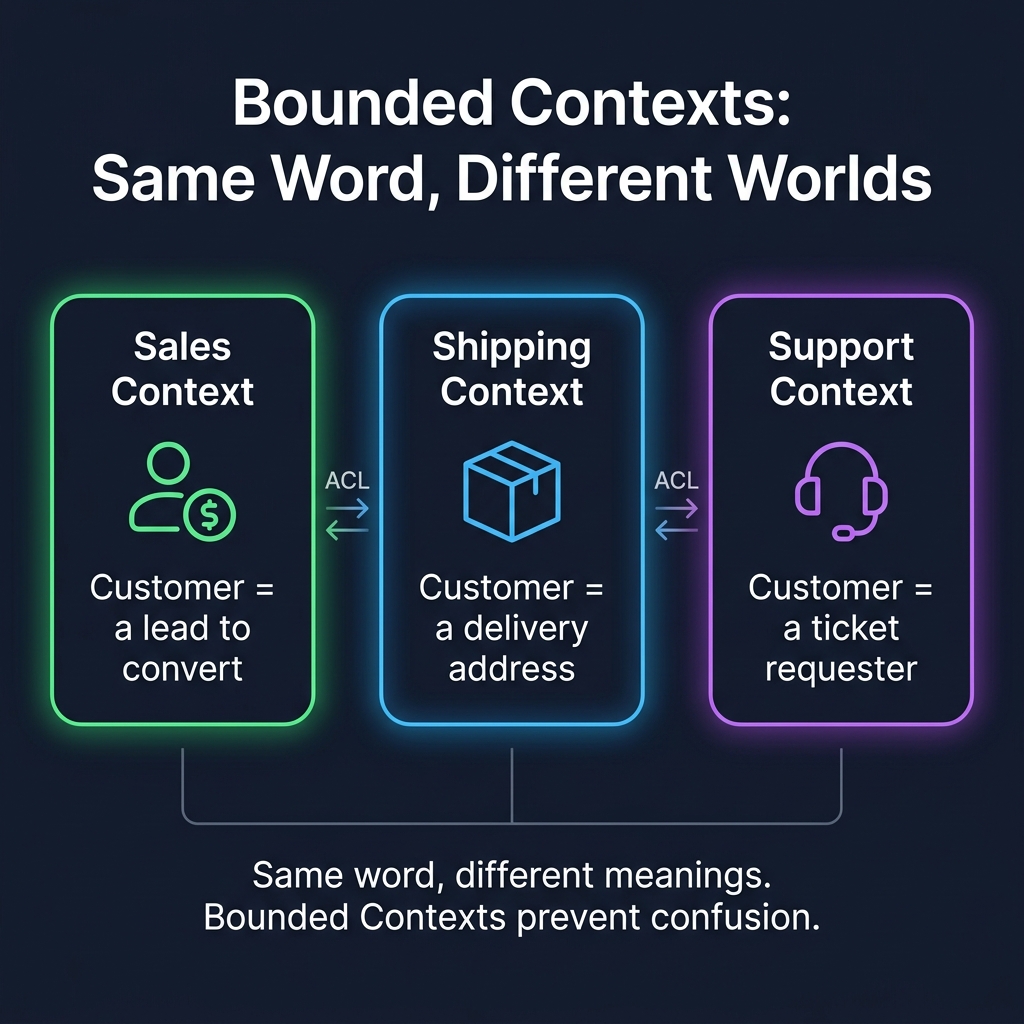 A word is only meaningful within a specific boundary.
Take the word Customer.
- To the Sales Team, a Customer is a lead—someone they are trying to convert. They care about email open rates and sales funnels.
- To the Shipping Team, a Customer is a physical address and a box dimension.
- To the Customer Support Team, a Customer is a ticket history and an SLA (Service Level Agreement).
If you try to build one giant Customer class in your code that satisfies all three departments, you will create a monstrous, fragile "Big Ball of Mud."
Instead, DDD tells us to create Bounded Contexts. A Bounded Context is a strict boundary (usually a separate microservice) where a specific model applies. Inside the "Shipping Context," the word Customer strictly means a shipping profile. Inside the "Sales Context," it strictly means a lead.
The Context Map
Because these Bounded Contexts eventually need to talk to each other to form a working business, architects draw a Context Map to define their relationships.
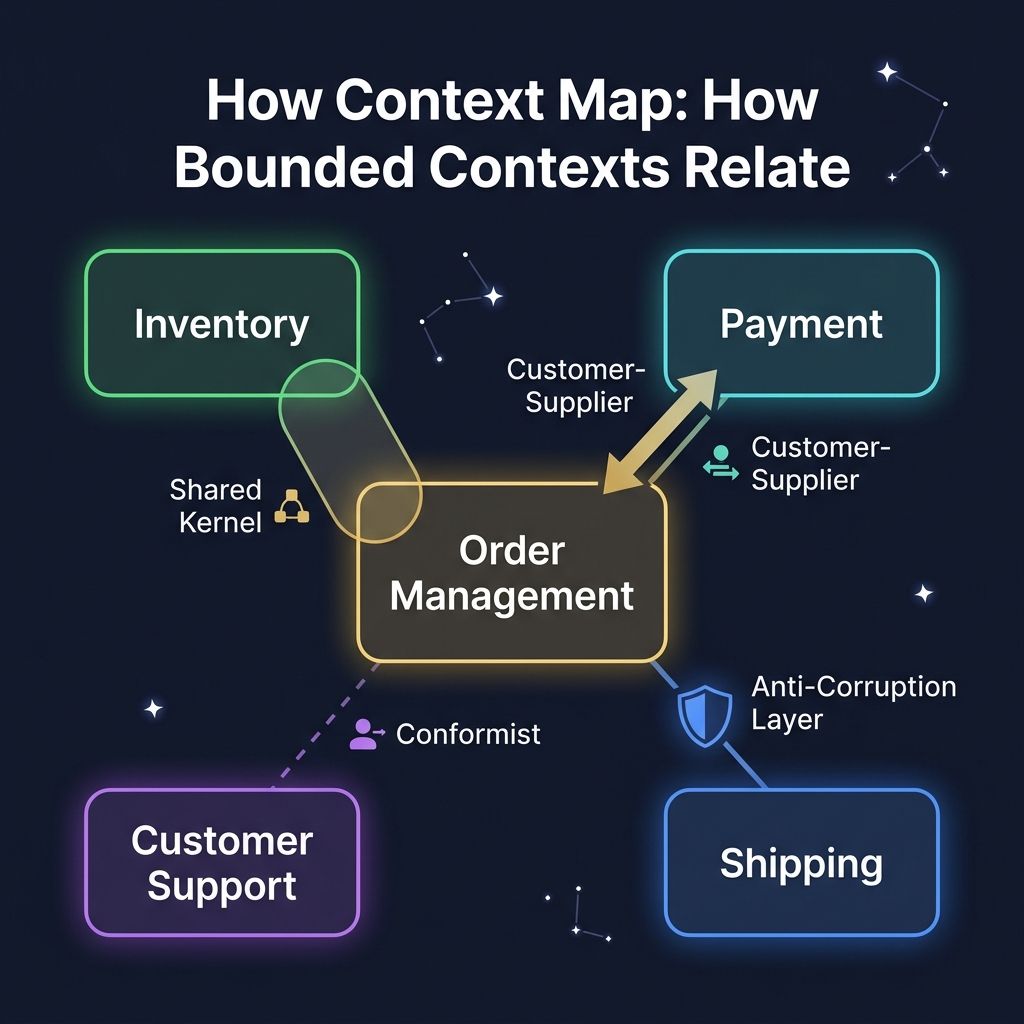 Defining the political and technical integration between teams.
For instance, if the Shipping Context relies on a shady third-party logistics API, you build an Anti-Corruption Layer (ACL) between them, so the messy third-party code doesn't infect your pristine internal model.
5. Tactical Design: The Solar System of Aggregates
Once the strategy is set, we move to the code. Complex business logic involves objects updating each other. If any object can update any other object directly, your database becomes a tangled web of inconsistencies.
To solve this, DDD introduces the concept of an Aggregate.
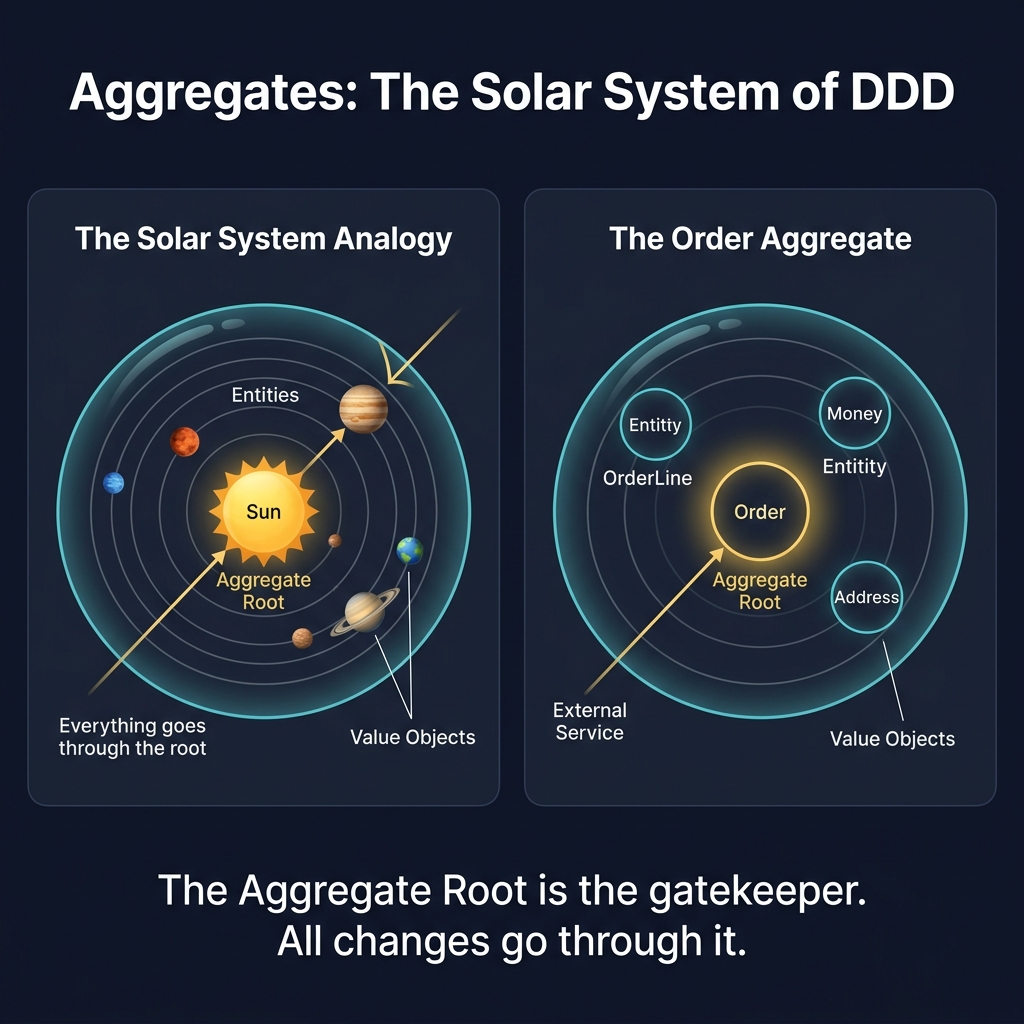 Aggregates act as the strict gatekeepers of consistency.
Think of an Aggregate like a Solar System.
- The Sun (Aggregate Root): There is one main object at the center, like an
Order. - The Planets (Entities and Value Objects): Other objects orbit it, like
OrderLines(the items bought) or theShippingAddress.
The strict rule of DDD is that nothing outside the solar system is allowed to touch the planets directly.
If the payment service wants to change an OrderLine, it cannot just reach in and update it. It must go to the Sun (the Order Aggregate Root) and ask it to make the change. The Order will then check all the business rules (e.g., "Is the order already shipped?") and only then modify the OrderLine.
By forcing everything through the Aggregate Root, you guarantee that your business rules are never bypassed and your data is always perfectly consistent.
The Verdict
Domain-Driven Design is not easy. It requires an upfront investment in time, communication, and architectural planning that many teams are too impatient to make.
However, when you are building complex enterprise software, DDD provides a vocabulary and a roadmap to prevent your codebase from degenerating into a chaotic mess. It reminds us that our primary job isn't to write algorithms—it's to capture business knowledge and turn it into working software.
References
This guide synthesizes principles and concepts from the following definitive texts on the subject:
- Domain-Driven Design: Tackling Complexity in the Heart of Software by Eric Evans (The "Blue Book")
- Learning Domain-Driven Design: Aligning Software Architecture and Business Strategy by Vladik Khononov
- Domain-Driven Design: A Pragmatic Approach by Eduard Ghergu
- Domain-Driven Design: The First 15 Years (Essays from the DDD Community)