Most people think Greek myths are dusty stories about toga-wearing statues. Stephen Fry's Mythos and Heroes prove the opposite: these are the most dramatic, violent, funny, and deeply human stories ever told. They invented every plot twist Netflix uses today.
In this guide, I'll walk you through the key mythological arcs using the Feynman Technique — breaking down the sweeping 3,000-year narrative into simple, clear sections that anyone can follow. Whether you've read the books or not, this is your map to the Greek mythological universe.
1. From Chaos to Creation: The Birth of Everything
The Simple Explanation
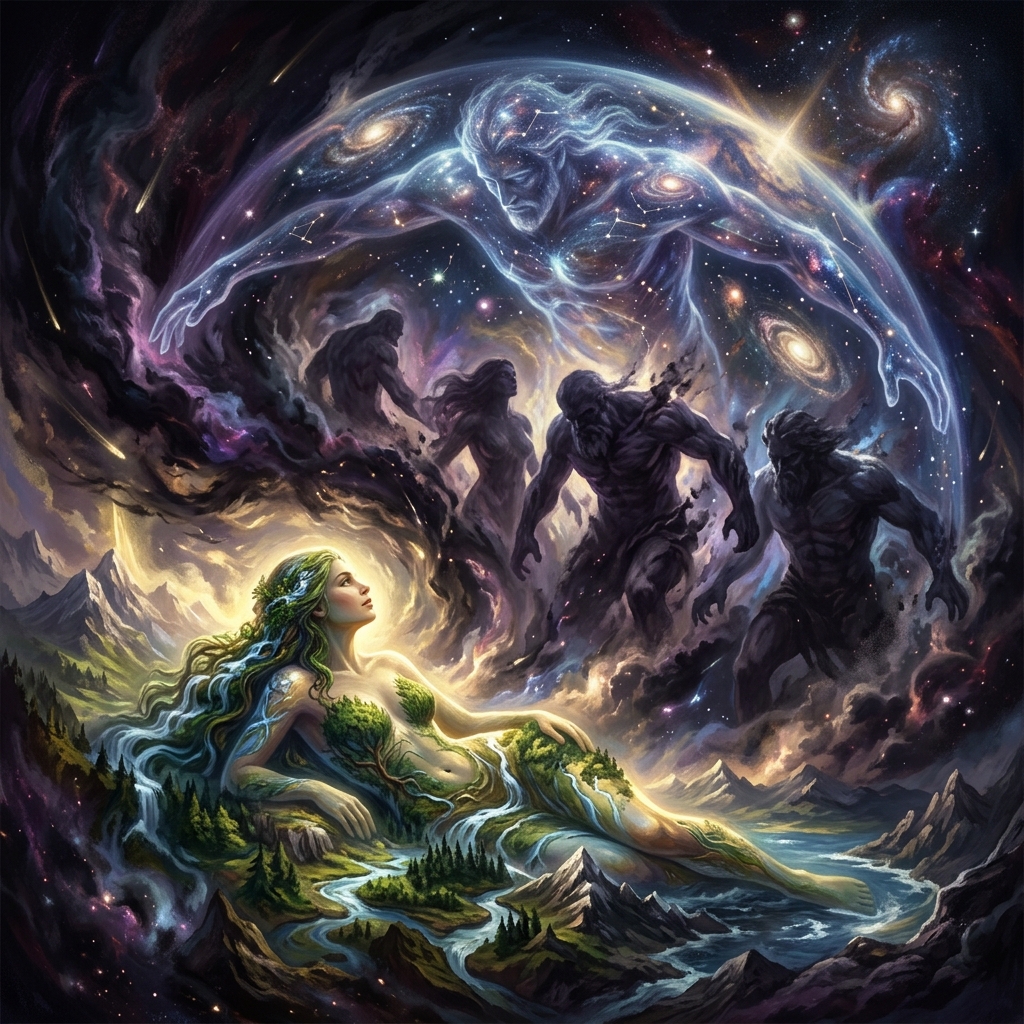
Forget the Big Bang. The Greeks said it all started with Chaos — not an explosion, but a yawning void, an infinite gap of nothingness. Think of it as the universe before someone turned the lights on.
From Chaos came the first beings: Gaia (Earth) and Tartarus (the deep underworld). Gaia, all by herself, produced Ouranos (Sky). Then Sky covered Earth — literally and figuratively — and from their union came the Titans: twelve colossal beings who ruled the cosmos before the gods you know ever existed.
Why It Matters in Fry's Retelling
Stephen Fry makes these abstract cosmic births feel personal. Gaia isn't just "the earth" — she's a mother who watches her children get imprisoned inside her own body by their jealous father Ouranos. The violence is visceral: Kronos, the youngest Titan, castrates his own father with a sickle to free his siblings. The blood that falls creates the Giants and the Furies. The severed flesh that falls into the sea foams up and produces Aphrodite, the goddess of love.
Every beautiful thing in Greek myth is born from something terrible. That's the pattern Fry wants you to see.
2. The Olympians Take the Throne
The Simple Explanation
Kronos, the Titan king, heard a prophecy: one of his own children would overthrow him — just as he had overthrown his father. His solution? Swallow every child the moment it was born.
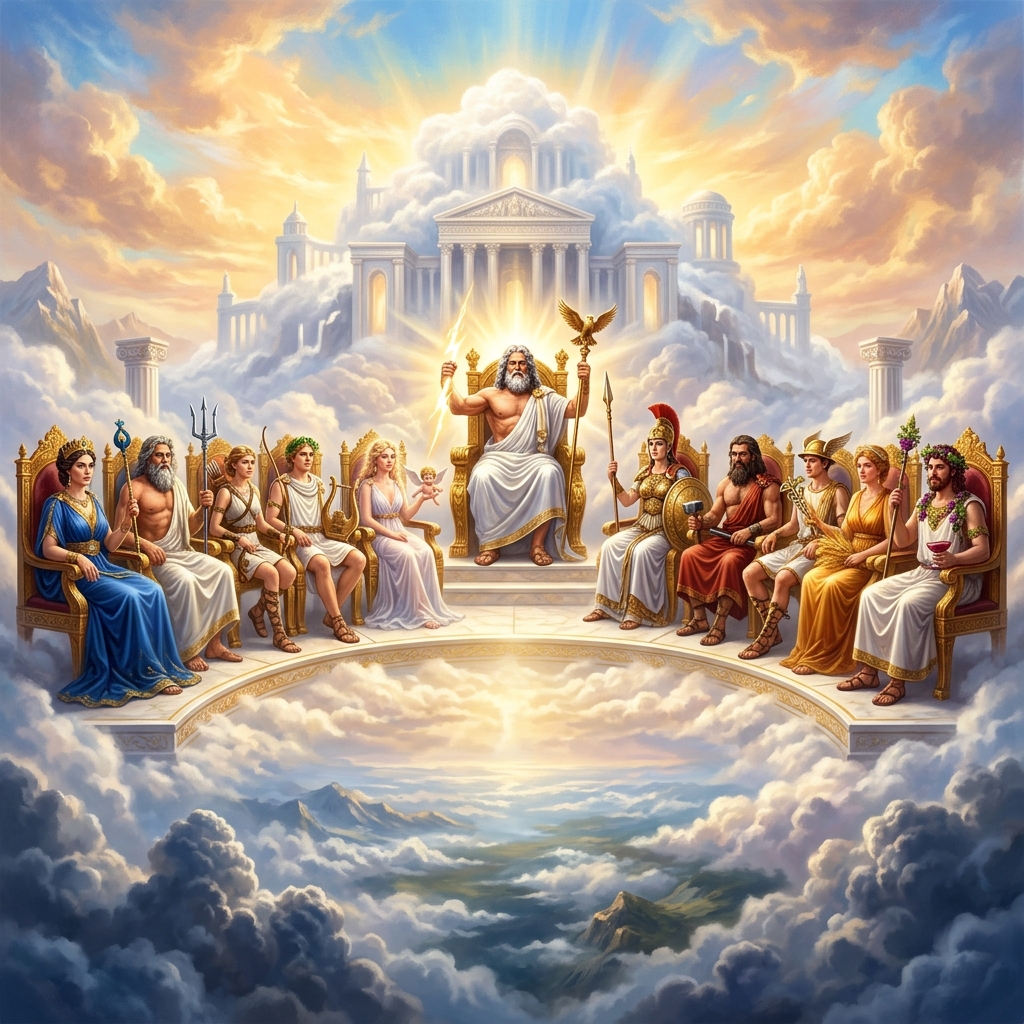
His wife Rhea managed to hide the youngest — Zeus — by wrapping a stone in swaddling clothes and feeding it to Kronos instead. Zeus grew up in secret, returned, and forced Kronos to vomit up all his siblings: Hera, Poseidon, Hades, Demeter, and Hestia.
Then came the Titanomachy — a ten-year war between the old Titans and the young Olympians. Zeus won, banished the Titans to Tartarus, and divided the world with his brothers: the sky for Zeus, the sea for Poseidon, the underworld for Hades. The earth was shared by all.
What Fry Gets Right
Fry presents Zeus not as a wise king but as a charming, insecure CEO running the universe like a startup after a hostile takeover. He's constantly worried about being overthrown himself, and that anxiety drives half the plots in Greek mythology. Every time Zeus falls in love with a mortal (which is constantly), the fallout creates a new hero, a new monster, or a new constellation.
3. Prometheus and the Gift of Fire
The Simple Explanation
Prometheus was the one Titan who sided with Zeus during the war. He was clever, charming, and genuinely loved humanity. Too much, as it turned out.
When Zeus wanted to keep the best parts of sacrificed animals for the gods, Prometheus tricked him with a deceptive offering: bones wrapped in glistening fat (which looked delicious) versus the good meat hidden inside an ugly ox stomach. Zeus chose the pretty package and got bones. Furious, he took fire away from humanity as punishment.
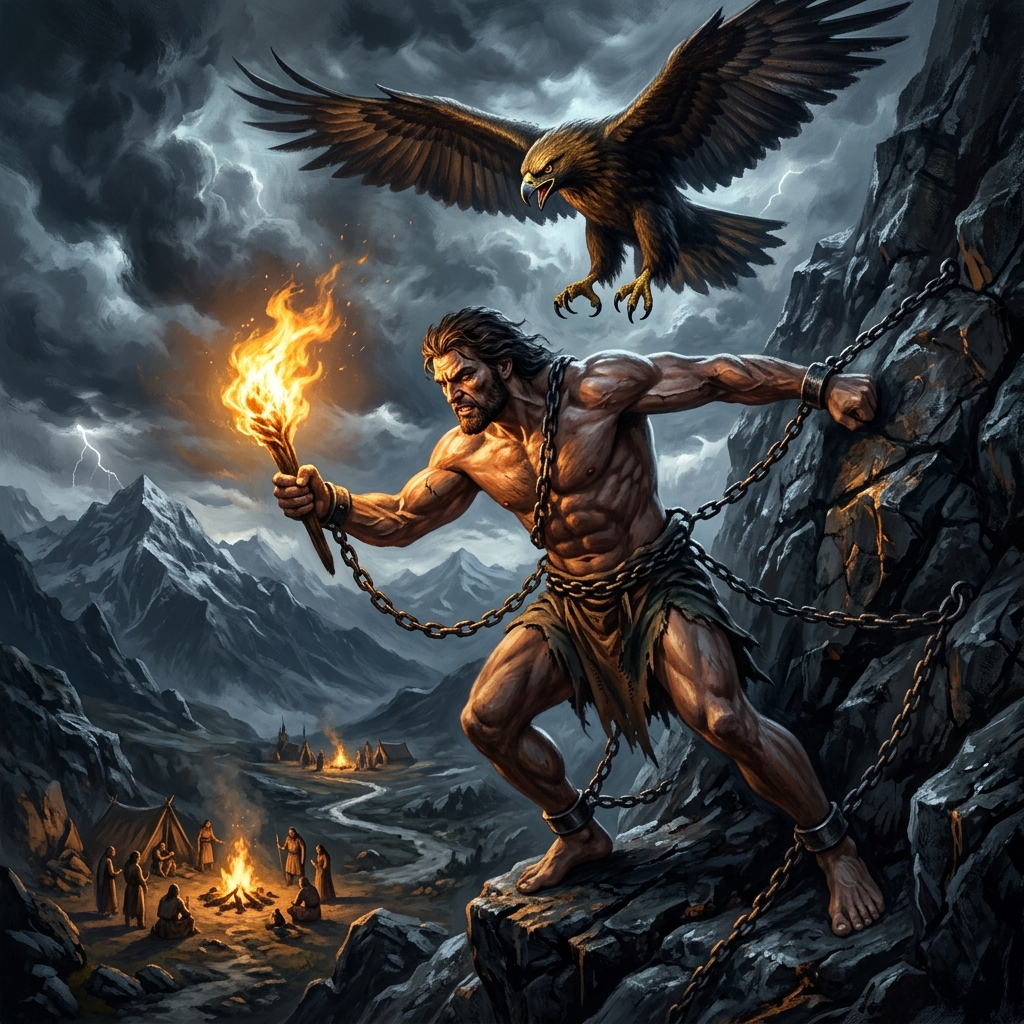
Prometheus stole it back — smuggling a flame inside a fennel stalk — and gave it to mankind. Fire meant cooking, warmth, metalwork, civilization itself.
Zeus's revenge was twofold: he chained Prometheus to a mountain where an eagle ate his liver every day (it grew back each night, so the torture was eternal). And he sent Pandora — the first woman, crafted by the gods and carrying a jar full of every evil — down to humanity as a "gift."
Fry's Insight
Fry frames Prometheus as the original rebel with a cause. He doesn't steal fire because he hates the gods — he does it because he can't bear to watch humans shiver in the dark. It's the first story ever told about the cost of progress: every leap forward comes with a punishment attached.
4. Perseus and the Gorgon: The Original Quest Hero
The Simple Explanation
In Heroes, Fry shifts from the gods to their mortal children. Perseus is the son of Zeus and a human princess named Danaë, who was locked in a bronze tower by her father after an oracle warned that her son would kill him.
Zeus, being Zeus, entered the tower as a shower of golden light. Danaë became pregnant. Her father put her and the baby in a wooden chest and cast them into the sea. They survived, washed ashore, and Perseus grew into a brave young man.
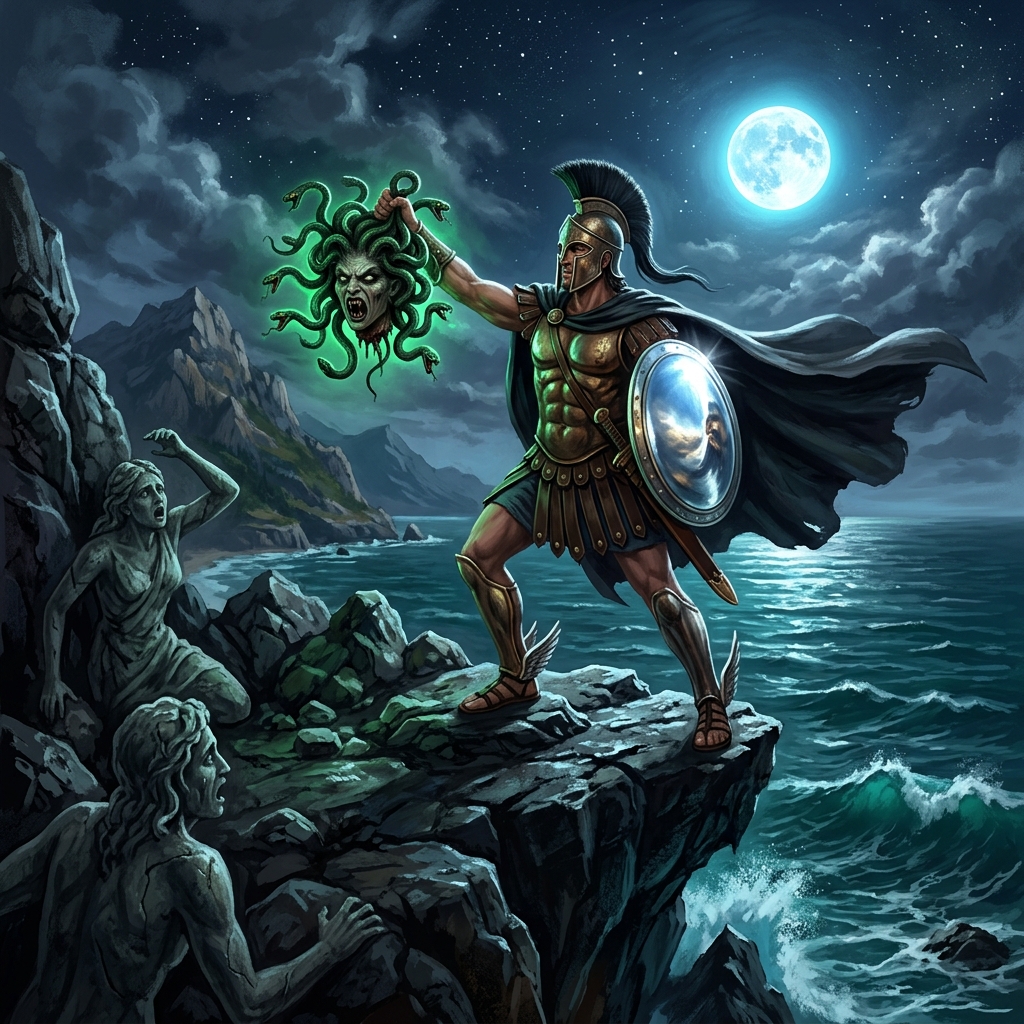
His quest: kill Medusa, the Gorgon whose gaze turned anyone to stone. Armed with a mirrored shield from Athena, winged sandals from Hermes, and a cap of invisibility from Hades, Perseus flew to the Gorgons' island, approached Medusa while she slept, used the shield's reflection to aim his sword, and severed her head without looking directly at her.
On the way home, he rescued Andromeda — a princess chained to a cliff as a sacrifice to a sea monster — by turning the monster to stone with Medusa's head.
Why This Story Endures
Fry points out that Perseus isn't a brute. He succeeds through cleverness, preparation, and the help of others. He is equipped by the gods, advised by allies, and wins by looking at the problem indirectly. In Fry's telling, Perseus is proof that the best heroes are the ones smart enough to ask for help.
5. Heracles: The Labours of a Demigod
The Simple Explanation
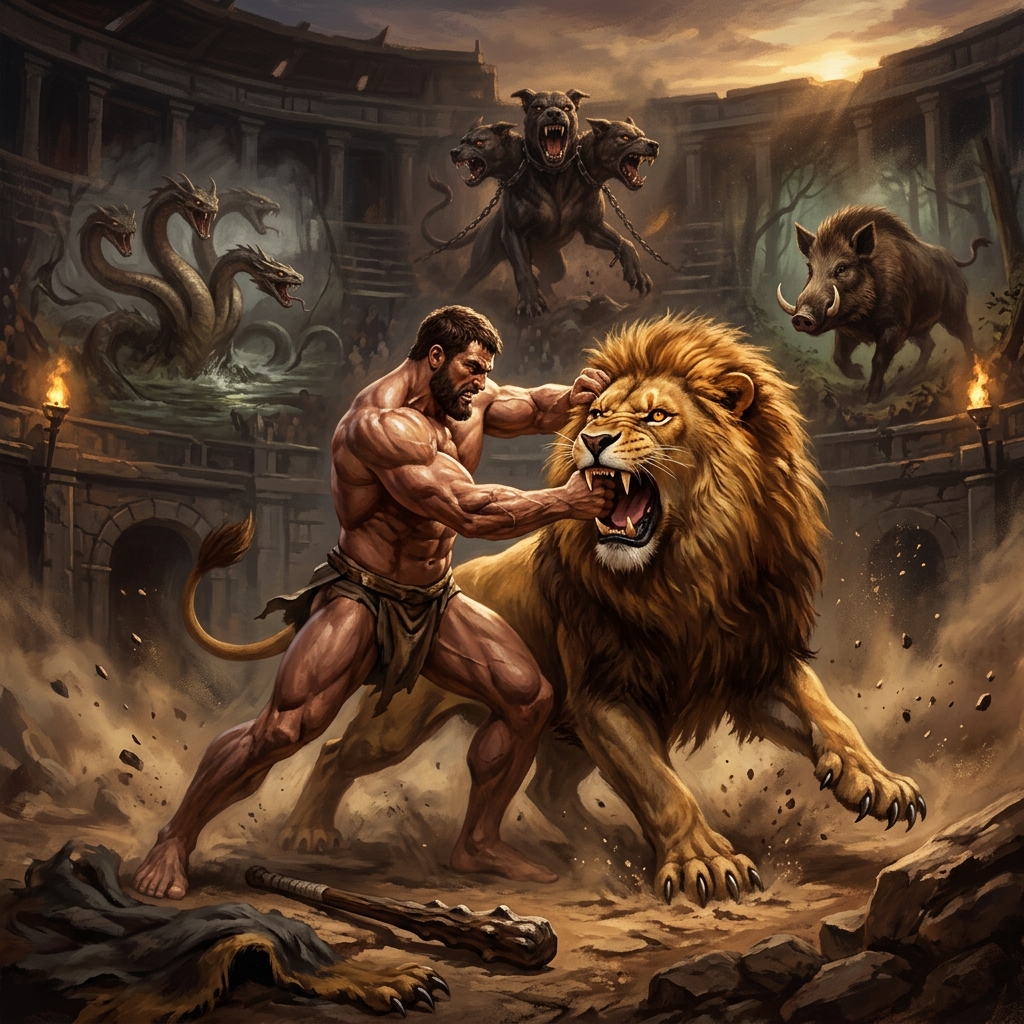
Heracles (the Greek name; the Romans called him Hercules) is the most famous hero in all mythology — and the most tragic. He was Zeus's son by a mortal woman, which made Hera, Zeus's wife, despise him from birth. She sent serpents to kill him in his cradle. The baby Heracles strangled them with his bare hands.
As a man, Hera struck him with a divine madness that caused him to kill his own wife and children. When the madness lifted and he saw what he had done, he was shattered. As penance, the Oracle at Delphi commanded him to serve King Eurystheus and complete twelve impossible labours:
- Slay the Nemean Lion (whose hide couldn't be pierced by any weapon)
- Kill the Lernaean Hydra (a serpent that grew two heads for every one cut off)
- Capture the Ceryneian Hind (sacred to Artemis)
- Capture the Erymanthian Boar
- Clean the Augean Stables (thousands of cattle, never cleaned, in a single day)
- Drive away the Stymphalian Birds (man-eating bronze-beaked birds)
- Capture the Cretan Bull
- Steal the Mares of Diomedes (horses that ate human flesh)
- Obtain the Belt of Hippolyta (queen of the Amazons)
- Steal the Cattle of Geryon (a three-bodied giant)
- Fetch the Golden Apples of the Hesperides
- Capture Cerberus (the three-headed dog guarding the underworld)
Fry's Take on Heracles
Fry writes Heracles as someone whose greatest enemy is himself. He has unlimited physical strength but limited emotional control. He wins every fight but loses everything he loves. His story isn't about triumph — it's about whether suffering can be redeemed. When he finally dies (poisoned by a shirt soaked in the blood of a centaur he killed), Zeus lifts him to Olympus and makes him a god. The message: the only way out of mortal pain is through it.
Why Read Stephen Fry's Greek Myths?
These aren't academic textbooks. Fry writes like he's telling you these stories in a pub — with the wit of a comedian, the vocabulary of a polyglot, and a genuine love for every ridiculous, tragic, beautiful detail.
Mythos covers the origin of the universe, the rise of the gods, and the first interactions between immortals and mortals. Heroes picks up the thread with the great questing heroes — Perseus, Heracles, Orpheus, Jason, Theseus, Atalanta, and Oedipus.
Together, they form the most accessible, entertaining, and complete retelling of Greek mythology available today.
If you've ever wondered why these stories — invented over 2,500 years ago — still show up in every Marvel movie, every Shakespeare play, and every therapy session about father issues, these two books are your answer.
Written by Chema Cabeza • Published on August 26, 2026 • Illustrated with AI