Distributed systems are the backbone of modern software. We want our systems to store massive amounts of data, run across hundreds of servers, and never go down. But there is a fundamental law of physics in computer science that says you cannot have everything: the CAP Theorem.
Often described using dry, academic jargon, the CAP Theorem is actually incredibly intuitive.
To make this concept clear, let's apply the Richard Feynman Technique: breaking down the CAP Theorem (Consistency, Availability, and Partition Tolerance) using a simple, real-world analogy of two local bookstore clerks.
The Clerk Analogy: Alice, Bob, and the Notebooks
Imagine you own a bookstore franchise with two locations in town.
- Location A is run by a clerk named Alice.
- Location B is run by a clerk named Bob.
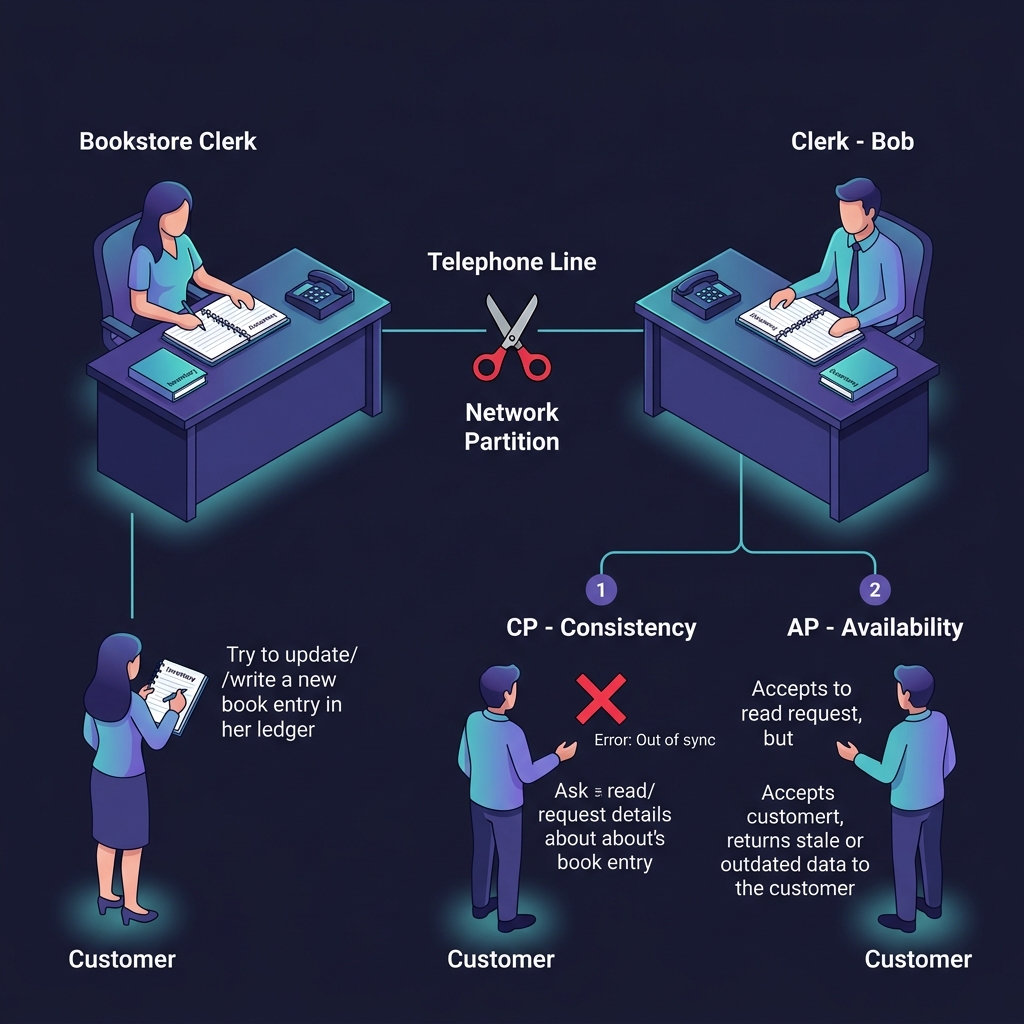 Alice and Bob maintain inventory notebooks connected by a telephone line.
Both stores sell the same popular programming book: "Designing Data-Intensive Applications."
To make sure they don't sell more copies than they actually have, Alice and Bob each keep a notebook representing the total franchise inventory. To keep their notebooks in sync, they have a telephone line connecting their desks.
Every time a customer buys a book from Alice, she updates her notebook and immediately calls Bob: "Hey Bob, I just sold a copy. Subtract one from your total." Bob writes it down, and their notebooks match perfectly.
Now, let's translate this bookstore setup into distributed system terminology:
- Alice and Bob are two separate database servers (nodes).
- The Notebooks are the database storage.
- The Telephone Line is the network connecting the servers.
- The Customers are user clients making reads and writes.
1. The Three Pillars of CAP
The CAP Theorem is built on three pillars:
Consistency (C)
In the CAP Theorem, Consistency means Linearizability (or strong consistency). It guarantees that every read request receives the most recent write or an error.
- Bookstore Analogy: If a customer walks into Alice's store and buys the last book, Alice updates her notebook to
0. If another customer walks into Bob's store a millisecond later and asks, "Do you have the book?", Bob must look at his notebook and say "No" (or throw an error if he isn't sure). Under strict consistency, both clerks must always give the exact same answer.
Availability (A)
Availability means that every non-failing server in the system returns a non-error response for every request—without a guarantee that it contains the most recent write.
- Bookstore Analogy: If a customer walks into either store and asks about a book, the clerk must give a definitive answer (like "Yes, we have 3" or "No, we have 0"). The clerk cannot hang up, say "Sorry, my phone is ringing, I can't help you," or keep the customer waiting for hours.
Partition Tolerance (P)
Partition Tolerance means the system continues to operate despite an arbitrary number of dropped or delayed messages by the network between the servers.
- Bookstore Analogy: A construction worker outside accidentally cuts the telephone wire. Alice and Bob can no longer call each other. A Network Partition has occurred. Despite this communication breakdown, both stores must stay open and continue serving customers walking through their doors.
2. The Dilemma: Why "CA" is an Illusion
The core of the CAP Theorem is this: You can only choose two out of the three properties.
But in reality, it's even simpler. You cannot choose "CA" (Consistency + Availability).
In a distributed network, physical components fail, routers crash, and cables get cut. Network partitions (P) are an unavoidable reality. You cannot opt out of Partition Tolerance. Therefore, when a network partition occurs, you are forced to make a binary decision:
- Choose Consistency over Availability (CP).
- Choose Availability over Consistency (AP).
Let's see what happens to Alice and Bob when the phone line is cut:
Option CP: Consistency + Partition Tolerance (Refusing Requests)
Alice's phone is dead, and a customer walks in to update their pre-order details. Alice records it, but she cannot call Bob to update his notebook.
Moments later, a customer walks into Bob's store and asks, "What are my pre-order details?" Bob knows his phone line is cut. He realizes his notebook might be stale (since Alice might have updated something he doesn't know about).
To guarantee Consistency, Bob must refuse to answer. He tells the customer: "I'm sorry, our system is currently offline. I cannot look up your account."
- Result: The data remains consistent (no one reads stale data), but the system is unavailable (the customer got an error).
Option AP: Availability + Partition Tolerance (Accepting Stale Data)
In this scenario, we prioritize Availability.
When the customer asks Bob for their pre-order details, Bob decides to answer anyway. He reads his notebook and says: "Here is your information." Even though it might be stale because Alice updated it five minutes ago, Bob returns a response.
- Result: The system is highly available (the customer got an answer immediately), but consistency is sacrificed (the customer read stale data).
3. Extending the Equation: The PACELC Theorem
In 2012, computer scientist Daniel Abadi realized that the CAP Theorem only describes what happens when a system is failing (during a network partition). But what about when things are running normally?
He formulated the PACELC Theorem:
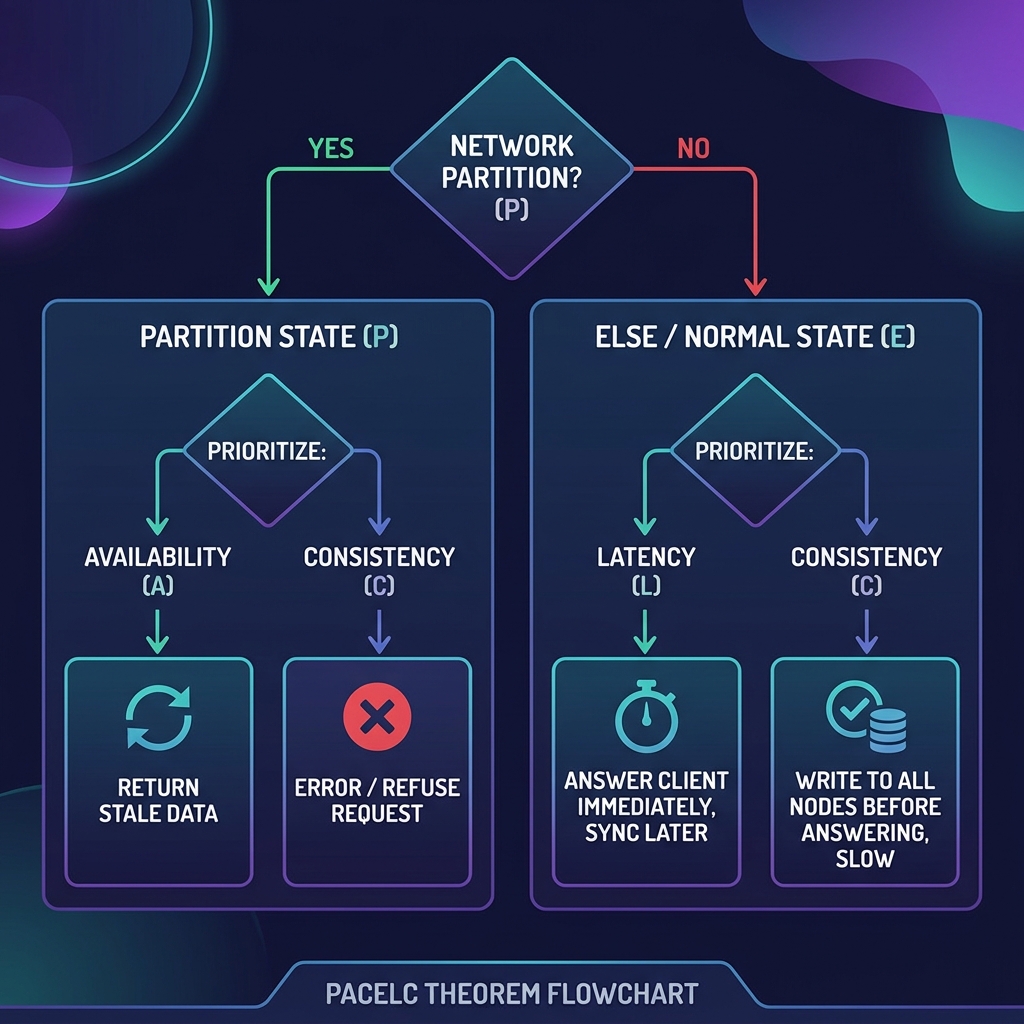 The PACELC Theorem flowchart: choosing trade-offs in both partition and normal states.
It reads: If there is a Partition (P), how does the system trade off Availability (A) vs Consistency (C)? Else (E), how does the system trade off Latency (L) vs Consistency (C)?
When the telephone line is working perfectly (Normal State):
- Latency Trade-off (PA/EL): If Bob wants to answer customers instantly (Low Latency), he won't wait for Alice's confirmation call before replying to a query. They will sync up in the background later.
- Consistency Trade-off (PC/EC): If Alice and Bob want absolute consistency, when Alice makes a change, she will keep the customer waiting at her desk while she calls Bob, waits for him to write it down, double-checks his entry, and then finishes the transaction (High Latency, High Consistency).
4. Real-World Database Trade-offs
Different databases are designed for different spots on the CAP/PACELC spectrum.
| Database | CAP Profile | PACELC Profile | How It Behaves in a Partition |
|---|---|---|---|
| MongoDB | CP | PC/EC | If the primary replica set node is partitioned, writes halt. The minority partition stops accepting writes until a new primary is elected. |
| Cassandra / DynamoDB | AP | PA/EL | Accepts writes on any node. Partitions function independently. Resolves data conflicts later via Last-Write-Wins (LWW) or vector clocks. |
| PostgreSQL (Replicated) | CP / AP (Configurable) | Configurable | Synchronous replication makes it CP (writes wait for replication). Asynchronous replication makes it AP (reads from read-replicas may return stale data). |
When to Choose CP (Consistency)
Choose a CP design when accuracy is non-negotiable.
- Examples: Financial ledgers, stock trading platforms, double-booking prevention, and identity access control.
- Why: It is better to reject a transaction (throw an error) than to let a user spend the same dollar twice (double-spending).
When to Choose AP (Availability)
Choose an AP design when system uptime and user experience are key, and minor data staleness is acceptable.
- Examples: Social media feeds, shopping carts, chat messaging, and analytics telemetry.
- Why: A user won't mind if a post comment takes a few seconds to appear for their friends, but they will be frustrated if the entire website refuses to load.
Summary
The CAP Theorem is not a design flaw; it is a fundamental law of physics for networked systems:
- Consistency (C): All nodes see the same data at the same time.
- Availability (A): Every request receives a successful response.
- Partition Tolerance (P): The system continues running even when communication lines are broken.
- The Trade-off: Since network glitches are inevitable, you must choose to either reject requests to stay consistent (CP) or accept stale data to stay available (AP).
The next time you design a distributed service, think of Alice and Bob and their notebooks. Ask yourself: "If their phone line gets cut, should they turn away customers or give them the old numbers?" The answer to that question is your architectural blueprint.